
Artificial intelligence is changing how legal professionals work, from drafting contracts to reviewing complex documents. However, much of the investment in legal technology has focused on large law firms and corporate legal departments. For individuals, small businesses, and early-stage entrepreneurs, the cost of accessing advanced legal support remains a significant barrier.
Talking Tree is taking a different approach. Instead of building exclusively for organizations with substantial legal budgets, the California-based nonprofit is developing AI-powered tools designed to make everyday legal tasks more accessible and affordable.
Founded in 2024, Talking Tree operates as a 501(c)(3) nonprofit with a straightforward mission: legal technology should be priced according to the cost of delivering the service rather than the need to maximize profits. This approach offers an alternative in a market increasingly shaped by well-funded commercial platforms.
Making Legal Technology Accessible Beyond Large Firms
For large corporations, legal software can fit neatly into an established technology budget. Small business owners, independent professionals, and entrepreneurs face a different reality. Negotiating a lease, preparing incorporation documents, or understanding a complicated contract can quickly become expensive when professional legal assistance is required.
Talking Tree aims to address these everyday challenges through AI-assisted document drafting, contract review, and plain-language explanations. According to the organization’s stated pricing model, its services cost approximately 50–80% less than comparable market offerings.
Rather than requiring customers to commit to large enterprise contracts, Talking Tree charges according to actual usage. Its pricing starts at around $20 per user per month, potentially making its tools more accessible to individuals and smaller teams.
The goal isn’t to replace lawyers in every situation. Instead, Talking Tree focuses on routine, high-volume tasks that consume time and resources. By helping users organize information, review documents, and understand legal language, the platform can make it easier to identify when professional legal advice is necessary.
Simplifying Everyday Legal Tasks
Legal documents often feel like they were written for other lawyers rather than the people who need to understand them. Dense terminology, lengthy clauses, and unfamiliar requirements can make even routine paperwork difficult to navigate.
AI-assisted tools can help users approach these tasks with greater confidence. For example, a small business owner might use document review features to identify clauses that deserve closer attention before consulting a lawyer. An entrepreneur could use drafting tools to prepare an initial version of a document for professional review.
These tools can help streamline the early stages of legal work, although users should still verify important information and seek qualified advice when decisions carry significant legal consequences.
A Different Approach to the Legal AI Market
The legal technology market includes well-funded companies such as Harvey and Legora. These businesses have invested heavily in workflow automation, integrations, and specialized tools for professional legal teams. Their platforms serve organizations that need sophisticated systems to support complex legal operations.
At the model level, Talking Tree, Harvey, and Legora largely rely on underlying frontier models from companies such as OpenAI, Anthropic, and Google. One notable development is Harvey Tenet, which Harvey has begun developing as a post-trained model. Harvey has reported promising results on its own benchmark, but those results have not been independently validated, so its broader effectiveness remains unestablished.
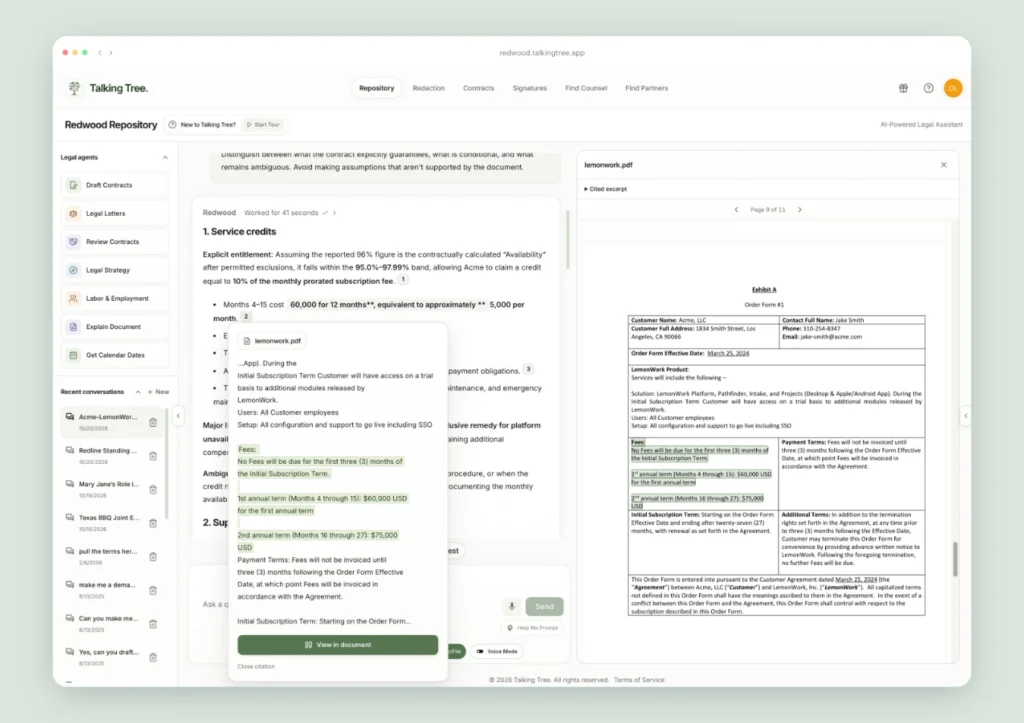
Talking Tree takes a more focused approach through its legal AI companion, Redwood. The platform brings together several practical features, including voice support, contract drafting and review, document redaction, and a library of templates. It also provides a way for users to connect with vetted lawyers when their circumstances require professional guidance.
Rather than trying to reproduce every enterprise feature offered by larger competitors, Talking Tree concentrates on legal workflows that individuals and smaller organizations regularly encounter.
This distinction matters because access to powerful AI models alone doesn’t guarantee a reliable legal technology product. Workflow design, security, accuracy, and appropriate human oversight all play important roles, particularly when users face decisions with potentially serious consequences.
A Founding Team With Experience Across Law and Technology
Talking Tree’s founding team combines experience in legal practice, software engineering, infrastructure, and product design. This mix helps shape a service intended to translate sophisticated technology into tools that everyday users can navigate.
Cecilia Wang: Turning Legal Experience Into Practical Solutions
Cecilia Wang brings experience from private practice and corporate legal departments. Her background includes antitrust work at Morgan Lewis, intellectual property litigation at Quinn Emanuel, and a federal clerkship with the U.S. District Court in Tennessee. She later moved into corporate legal roles in the semiconductor industry and at Meta.
Her experience as a senior legal executive at a smaller public company exposed her to the challenges faced by lean legal teams. Limited resources, demanding workloads, and fragmented information systems made routine work difficult to manage efficiently.
Wang developed AI workflows to improve productivity and reported that these efforts reduced legal spending by nearly half. That experience helped shape Talking Tree’s focus on solving practical problems rather than adopting technology simply because it is new.
Michael Greenwald: Building the Technology Behind the Platform
Co-founder Michael Greenwald serves as the founding engineer, responsible for Talking Tree’s core AI pipeline, backend business logic, and user interface.
A UCLA graduate who studied linguistics and computer science, Greenwald has spent years developing web and mobile applications. At the Los Angeles agency ISBX, he built backend systems and administrative tools for startups and established businesses.
His technical experience also extends to game development and augmented reality. At Stayhealthy, he helped develop Color Quest, an augmented-reality health app that surpassed three million downloads. He also helped reduce the app’s size by approximately 75% to improve performance.
Alex Lu: Connecting Technology With Design
Co-founder Alex Lu leads technology and infrastructure. Her career spans technical roles at Microsoft and Intuit, as well as visual design work at NASA’s Jet Propulsion Laboratory.
Lu has also worked in modeling under the stage name Alix Lu, collaborating with startups in a different capacity. Her experience includes producing investor-facing product videos and representing a virtual makeup try-on startup, which eventually featured her on the cover of Harper’s Bazaar Vietnam.
Together, the three UCLA graduates bring complementary skills to Talking Tree. None of the founders draws a salary from the organization, according to the supplied company information.
Why the Nonprofit Model Matters
Talking Tree’s nonprofit structure influences both its pricing strategy and its broader mission. As a nonprofit, the organization can direct revenue toward maintaining and improving its services rather than distributing profits to shareholders.
Its latest public filing, as described in the supplied information, reported approximately $427,000 in revenue and $407,000 in expenses. Donations and grants help support its work, allowing the organization to pursue its goal of making legal technology more accessible.
However, this model also presents challenges. A relatively small organization may struggle to match the security certifications, engineering capacity, and research budgets available to companies backed by hundreds of millions of dollars.
Maintaining reliable systems requires continuous investment. This is especially important when AI tools handle sensitive documents or generate information that users may rely on when making legal decisions.
Building Toward a More Accessible Legal Future
The long-term opportunity for Talking Tree lies in serving people who might otherwise rely on generic chatbots, search results, or unfamiliar online templates when facing legal questions.
These alternatives may cost little or nothing, but they don’t always provide structured document workflows, specialized review features, or access to professional legal support. Talking Tree aims to bridge that gap by combining practical AI capabilities with a more accessible pricing model.
Competition will continue to evolve. General-purpose AI assistants are becoming more capable, while established legal technology companies may expand their offerings to reach smaller customers. To stand out, Talking Tree will need to demonstrate that its affordability, focused functionality, and nonprofit governance offer lasting value.
Its success doesn’t necessarily depend on becoming the largest legal AI company. Instead, the organization is pursuing a different goal: making useful legal technology available to people who have traditionally been priced out of it.
By bringing together legal experience, engineering expertise, and a cost-conscious operating model, Talking Tree is exploring how AI can broaden access to everyday legal tools. Whether it can scale sustainably while maintaining accuracy, security, and reliability will depend on continued development, responsible oversight, and consistent funding.
Conclusion
Legal technology shouldn’t be available only to organizations with the largest budgets. Individuals, entrepreneurs, and small businesses also need practical ways to understand documents, prepare paperwork, and identify when professional legal help is necessary.
Talking Tree is working to make those tools more accessible through AI-assisted legal workflows, usage-based pricing, and connections to vetted lawyers. Its nonprofit structure sets it apart from commercial competitors, although it must still address the financial and technical challenges involved in delivering dependable legal AI.
The opportunity is clear: by focusing on affordability without overlooking responsibility, Talking Tree could help more people navigate routine legal tasks with greater confidence.
Explore the organization’s services through Talking Tree to learn more about its approach to accessible legal technology.